What Is the Offside Rule in Football? A Simple Explanation
Imagine this for just a second. It's the champions league final and your favourite team is a goal down and the clock is indicating 89 minutes. The teams No.10 makes a through pass to your striker who goes on to roll the ball past the keeper like he's been waiting all week to do it. The stadium erupts, the striker and his team mates are running towards the fans in celebration. You're shouting GOOAAALLLLL at the top of your voice while hugging a total stranger who’s wearing the same jersey as you.
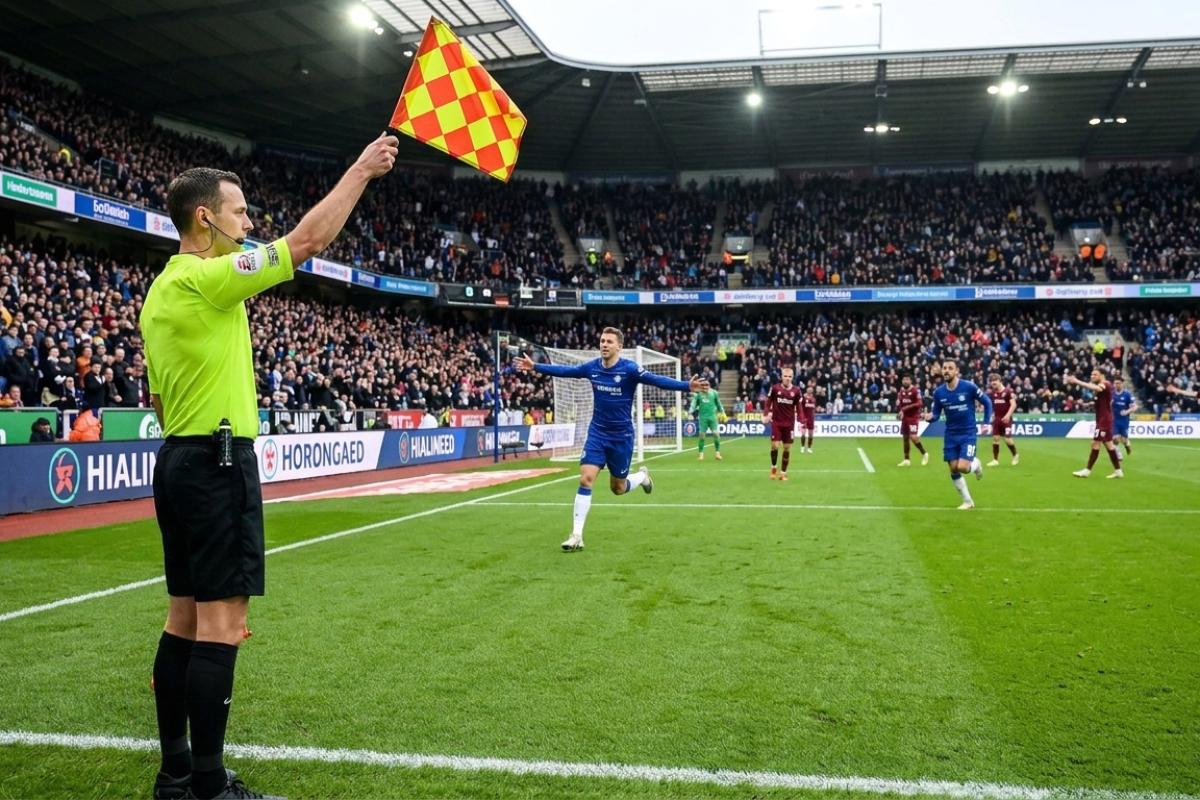
Then you spot the assistant referee standing at a spot with his flag raised up high in the air.
Suddenly, the celebration dies in just two seconds. Then someone behind you grumbles, "How is that an offside?!". Honestly, we’ve all at some point in our football fatalism asked that exact question. The offside rule is the most controversial rules in football and the craziest part is that most football fans think they understand it. To be honest, explaining exactly when a player is offside can be surprisingly difficult for beginners.
My primary aim for writing this article is to explain this rule the simplest way possible that even a six-year old would understand.. By the end of this article, you'll understand what the offside rule in football actually is, when it applies, when it doesn't, and why even the pros tend to argue some much about it.
The Offside Rule in One Sentence
First, lets start with the short version: you can't hang around near the opponent's goal waiting for the ball, with nobody between you and the goal except the keeper.
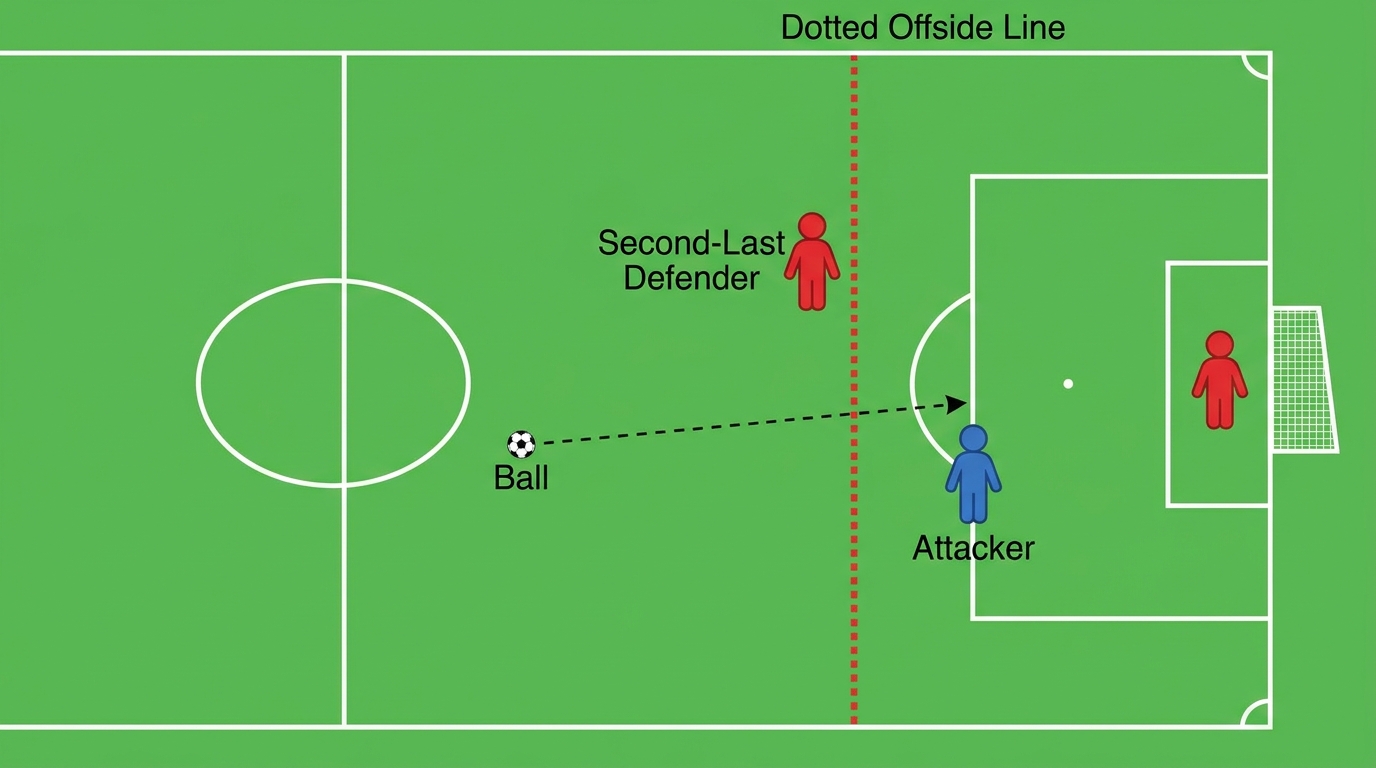
Now the more precise version says: a player is in an offside position if, when a teammate passes the ball, they are closer to the opponent's goal line than both the ball and the second-last defender.
That’s the core and summary of it all. Everything else is detail which this article intends to break down properly for everyone to understand.
Why does the Offside Rule Exists?
Don’t know about you, but growing up, I kept asking people, why does the offside rule even exist? Why not just let players stand wherever they like? I remember being told by one local football official that its because FIFA knew strikers would camp beside the goalkeeper like they were waiting for an Oshodi bus in Lagos and that would make football a very boring game for both the players and spectators.
As hilarious as that may sound, that’s the primary reason. Without offside, a team could plan a striker next to the opposition keeper for ninety minutes and just launch long balls at him. Nobody would build play and they won’t be need to defend in a line. Basically, football would become much easier for attackers and far less tactical for everyone else.
The rule keeps the game fair and keeps the action spread across the pitch. It forces attackers to time their runs and forces defenders to work together as a unit. Ever watched a back four step up together at exactly the right moment? That's the offside trap, and it's one of the most beautiful (and nerve-wracking) things in the sport.
The offside rule has been around since the earliest days of organised football, and it has changed more than once. In 1925, the number of defenders required between the attacker and goal dropped from three to two, and goals went up dramatically. The current rules are maintained by the International Football Association Board (IFAB), and you can read the official wording in their Laws of the Game, specifically Law 11.
Offside Position vs Offside Offence
The offside position and offence is where most of the confusion lives, so let's break it down.
Being in an offside position is NOT an offence by itself.
You read that correctly. A football player can stand in an offside position all day long and nothing happens, as long as they don't get involved in the play. The offence only happens when:
- A teammate plays or touches the ball, and
- The player in the offside position then becomes involved in active play. So it's a two-step thing. Position first and involvement second.
What counts as "involved in active play"?
There are three main ways a player gets flagged for an offside offence:
a. Interfering with play: they touch or play the ball that a teammate has passed or touched.
- b. Interfering with an opponent: they block the keeper's line of sight, challenge a defender for the ball, or make an obvious action that stops an opponent from playing it.
- c. Gaining an advantage: they play the ball after it rebounds off the post, the bar, or a defender (or after a deliberate save), when they were in an offside position beforehand.
If the player isn't doing any of those things, they're just standing there or walking away from the ball then the play will continue no offside offence will be called.
Which Body Parts Count?
Now we are getting into the detail that surprises and confuses most football fans. Offside is judged using any part of the body that can legally score a goal. That means the head, body, and feet.
Hands and arms don't count and that includes that of the goal keeper. For the purpose of offside, the top of the arm is roughly the bottom of the armpit, so an attacker can't be flagged for an outstretched hand being a few centimetres too far forward.
Also, if at is standing or running at the same level with the second-last defender, the play is consider to be in an onside position. No offside.
Quick Reference: Onside or Offside?
To help you quickly understand the dynamics of the offside rule, here’s a table you can screenshot and save for your next viewing center offside argument.
|
Situation |
Onside or Offside? |
|
Attacker is level with the second-last defender |
Onside |
|
Attacker is behind the ball when it's played |
Onside |
|
Attacker is in their own half |
Onside |
|
Attacker is ahead of the ball and the second-last defender, and plays the ball |
Offside |
|
Attacker is ahead of both but doesn't touch the ball or affect anyone |
Onside (no offence) |
|
Attacker is offside but only an arm is past the defender |
Onside |
|
Attacker is ahead of both and blocks the keeper's view of a shot |
Offside |
When You Can't Be Offside
This is another very interesting part about the offside rule that baffles some clueless football fans especially when their favorite team is the one playing. Interestingly, there are situations where offside rule doesn’t apply.
According to FIFA rule, you cannot be offside if you receive the ball directly from:
- A goal kick
- A throw-in
- A corner kick
So that classic stunt pulled by some stickers where they lurk at the far post whenever their team is about to take a corner is totally LEGAL even though its very annoying for defenders.
Also, a player can't be offside in his own half and you can't be offside by receiving a backward pass from a teammate who's ahead of you. Note also that offside position is judged at the very moment the ball is played not a second after.
|
Restart |
Can You Be Offside? |
|
Goal kick |
No |
|
Throw-in |
No |
|
Corner kick |
No |
|
Free kick (direct or indirect) |
Yes |
|
Penalty kick |
Yes (for players other than the taker) |
|
Dropped ball |
Yes |
The Second-Last Defender Explained
More often, I hear people say "the last defender," even though that is grammatically correct and sounds fine, the actual rule says second-last opponent. Why?
Because the goalkeeper usually counts as one of the opponents and the last one. So normally you need two opponents (most likely the goalkeeper and one defender) between you and the goal line, or at least be level with the second last opponent.
But here's a twist that makes football fans happy and crazy at different times: the goalkeeper doesn't necessarily have to be one of the two last opponents. In a situation where the keeper has run up the pitch for a corner, then the second-last opponent could be two outfield players. The rule doesn’t care about the jersey number, an opponent is an opponents.
To better understand the offside rule, here’s a tip for you. Next time you're watching match, don’t look at the keeper, pay attention to the second-last defender. That's the player who decides everything.
What About Passes Played by the Defending Team?
This right here is the most controversial offside call.
If a defender deliberately passes the ball to an attacker who was in an offside position it's not an offside. The offside position gets "reset" because the defender intentionally played the ball.
There's an important difference between a intentional pass and a deflection. A deliberate pass is a controlled, intentional action (a pass, a clearance with control). A deflection is when the ball just bounces off a defender who didn't mean it. If it's a deflection, the offside call can still stand.
Also, if a shot is saved and the ball falls to an attacker who was offside, they're still offside.
It sounds tricky and controversial but that’s literally why referees spend months undergoing trainings.
Famous Offside Moments
Every football fan has one offside call that remains fresh in their minds like it happened yesterday. For some it's a goal that was ruled out by the center referee for offside. While for others it's a goal that should have been ruled out.
Before the introduction of VAR and other technologies that has assisted with the offside calls, the assistant referees had to make an offside call in a split second with just the naked eyes while an attacker and the ball are in motion. Think about that for a moment, they literally had to look at the defensive line, watch the passer's foot, and track the runner, all at once. Human eyes just aren't built for such level of multitasking. Honestly, I have a lot of respect for the officials who did it for decades .
VAR and How Technology has Changed Football
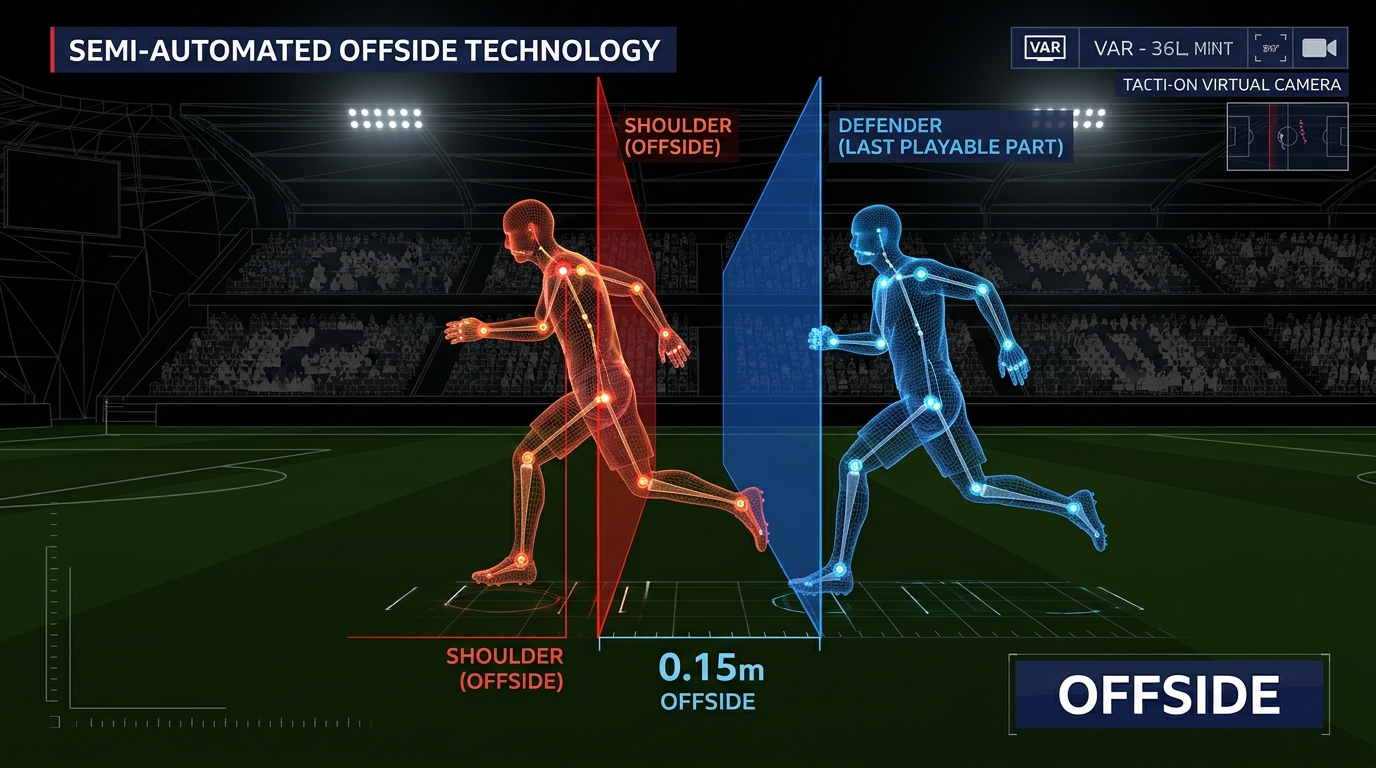
The Video Assistant Referee (VAR) was introduced to help officials correct clear and obvious refereeing errors, and offside is one of the areas where it's used mostly. Early on, VAR offside checks involved a person drawing lines on a frozen frame. It was accurate in theory, but it also led to goals being disallowed over margins of a few centimetres.
The more recent upgrade to the VAR is Semi Automated Offside Technology. It uses multiple tracking cameras and a sensor in the match ball to follow players' limbs and the exact moment the ball is kicked. It was used at the 2022 FIFA World Cup in Qatar and has since been adopted in many top leagues, including the Premier League and the La Liga
It's faster and more consistent than the old system and has stopped a lot of guess work. But then, that won't stop arguments and of course, nothing can stop arguments in football arguments.
Tips for Attackers: How to Beat the Offside Trap
If you’re a player, you've probably been flagged more often than you'd like to admit. A few practical habits to help you stay more consistently in an onside position:
- Watch the line, not just the ball. Know where the second-last defender is at all times.
- Time your run. Start from behind the defender and arrive late, not early.
- Move diagonally. Curved runs help you stay onside until the pass is played.
- Communicate with the passer. A nod or a glance helps you both agree on the moment.
- Stay patient. The best strikers aren't the fastest; they're the best at timing.
Tips for Defenders: How to Use the Rule
On the other hand, defenders can use the offside rupe as a weapon to outsmart their opponents:
- Step up together. One defender stepping up alone leaves everyone else caught out.
- Talk constantly. The loudest player in the back line is usually the one holding it together.
- Know when not to. A badly timed trap can leave a striker one-on-one with the keeper.
Why the Offside Rule Matters If You Bet on Football
For those of you who follow football with money on the line, this section is specially dedicated to you.
An offside decisions can change the outcome of a match, and that’s not always fair. I have seen a perfectly sensible bet go sideways because of a decision measured in centimetres.
That's exactly why smart bankroll management matters. You can't control offside calls, VAR reviews, or deflections. What you can control is how much you stake. A few simple principles:
- Set a budget you can afford to lose. Treat it as entertainment money, never rent money.
- Stake a small, fixed percentage per bet. Many bettors use 1 to 3 percent of their bankroll so that one bad call doesn't sink the month.
- Avoid chasing losses. A disallowed goal is annoying, but doubling your next stake won't "win it back."
- Keep records. Track your bets, stakes, and results so you can see what's actually working.
- Know the rules. Understanding offside, VAR, and how bets are settled (for example, whether a goal later ruled out still counts) helps you avoid surprises.
Betting should stay fun. If it stops being fun, or you feel you can't stop, it's worth reaching out to a support service in your country. Gambling is risky, and no strategy guarantees profits.
Common Offside Myths
Let's clear a few things up.
- "You can be offside from a throw-in." Nope. Never.
- "If you're level, it's offside." Also no. Level is onside.
- "The keeper has to be the last defender." Not true. It's about the second-last opponent, whoever they are.
- "Offside only matters if you score." Wrong. It matters whenever you get involved in play.
- "A player in an offside position is always offside." Not unless they're involved in play.
Frequently Asked Questions
What is the offside rule in football in simple terms?
A player is offside if they're closer to the opponent's goal line than both the ball and the second-last defender when a teammate plays the ball, and they get involved in the play.
Can you be offside in your own half?
No. You can only be in an offside position in your opponent's half.
Can you be offside if you're level with the last defender?
No. If you're level with the second-last opponent (or the last two opponents), you're onside.
Is the goalkeeper counted as a defender for offside?
Yes, the goalkeeper counts as an opponent. But the rule refers to the second-last opponent, who is often an outfield defender.
Can you be offside from a corner kick?
No. There's no offside from corners, goal kicks, or throw-ins.
Does VAR check every offside?
VAR reviews goals and certain key incidents. It doesn't check every single flag in every game, but it checks the ones that lead to or cancel a goal.
Why was my goal disallowed if the player didn't touch the ball?
Because involvement isn't only about touching the ball. A player who blocks a keeper's line of sight or challenges a defender can be penalised for interfering with an opponent.
Summary
The offside rule feels complicated because people try to learn all the exceptions at once. Start with the basics instead: position, then involvement. Once those two ideas click, the rest falls into place.
And next time a goal gets ruled off, you can be the one in the viewing center who quickly explains to those shouting “how is that an offside?”.
So here's my challenge. At your next match, watch only the second-last defender for ten minutes. See how often the flag goes up, and whether you can call it before the officials do. Then come back, drop your best (or worst) offside story in the comments, and share this guide with the friend who still thinks you can be offside from a throw-in.
Albert Akpama (Albertflex) is a tech guru, football enthusiast and sports writer that’s passionate about making football predictions easier to understand. He focuses on match analysis, prediction strategies, bookmaker reviews and betting insights, helping readers understand the key factors that influence football match results. At 1Banter, Albert combines his passion for football with a practical, evidence-based approach to analysing matches.
All author postsRelated posts
0 Comments
- No comments yet. Be the first to share your thoughts.
Login to post a comment.